mad.co.uk, an online magazine for creative and media characters whose weekly email I’ve somehow managed to subscribe to, are currently running an “election special”, approaching leading branding and design agencies to “revamp the visual identities and brand positioning” of the main parties. This week they’re focusing on the Liberal Democrats, whom Thoughtcat believes represent the only decent choice in the coming election. The posters and slogan (“Honesty is our best policy”), created by The Design Group, is pretty good IMHO, and has prompted me to have a go myself. I’m no professional designer or ad person (“No kidding!” – The Design Group) but I’ve come up with three newspaper ads / posters and put them on my main site at www.thoughtcat.com/libdems.htm
The new Who
The newly revamped classic BBC sci-fi series finally launched on Saturday night and I was, naturally, at the TV like a shot. For all the money poured into the production it felt rather tame compared to the Who of Thoughtcat’s youth (which is saying something, as “my” Doctor was Peter Davison), and it did try a bit too hard to be trendy. That said, respectively, an attack of faceless child mannequins was fairly unnerving, and the Beeb could have done (and indeed have done) a whole lot worse than Christopher Eccleston as the new Who and Billie “Second Billie of the Day [sic]” Piper as his Lovely Assistant. The peppering of the script with essential Who factoids (what TARDIS stands for, the fact that it’s bigger on the inside than out, the sonic screwdriver etc etc) also grated a bit, but then the BBC are looking for a new audience and I should hand it to writer Russell T. Davies for managing to both entertain and give everyone a crash course on all things Who in the space of less than an hour. It’s good to hear that the Daleks will return at some point, although the news that “this time they can fly” surely represents a fundamental misconception of what Dr Who is all about: the whole point of the Daleks is that they couldn’t climb stairs! It was one of their main weaknesses! It’s a bit like revamping Superman without the Kryptonite.
I thought Ecclestone was a good choice for the new Doctor, as the BBC’s increasing dependence on unheard-of whacky oddballs to portray him, culminating in the preposterous Sylvester McCoy, was one of the reasons the series self-destructed in the late 80s. No doubt our friends in the north (ho ho!) are happy to finally have a Doctor not sporting a Home Counties accent, and the pairing of the Mancunian with Piper, a Londoner, is inspired. It was also good to see the sense of humour (another Who essential) in evidence, such as when Ecclestone tore the head off a malignant plastic alien, and found time in the ensuing chaos to grin broadly at the grotesque object in his hands. It was in fact something of a revelation to see Ecclestone smile at all – the Doctor may actually be the first role which has ever made such a demand on the notoriously intense actor. Maybe this series will give him some practice, and he’ll go on to play other smiling parts on the big screen in the future? I sincerely hope so.
On the whole I enjoyed the first episode and don’t plan to be anywhere other than in front of the box at 7pm for the next several Saturdays. I hope it gets scarier, though.
‘Sad am I’
A nice article in Saturday’s Guardian Review on a new book about Billie Holiday:
In November 1956, Holiday was interviewed by Tex McCreary. She sounds heavy with alcohol and whatever drugs she might have been using, and the conversation is slow and awkward. The interviewer obviously feels it’s no good going on with the questions and she was in no fit state to sing, but he has a sudden inspiration. He asks her to recite one of her songs. “I want you to close your eyes, Billie,” he says, “and speak the words like a poet. What about ‘Yesterdays’?”
Without a moment’s hesitation she does what she has been told to do. She recites the words with an almost unbearable languor, but with all the power and authority of a great theatrical monologue. Her voice sounds like a song, so musical in its resonances that as you listen you seem to hear a band playing with her:
Yesterdays,
Days I knew as happy sweet,
Sequestered days,
Olden days, golden days,
Days of mad romance and love.
Then gay youth was mine,
Truth was mine,
Joyous free and flaming life,
Forsooth were mine.
Sad am I, glad am I,
For today I’m dreaming of,
Yesterdays…
Go to the cinema and end up the star of your personal film
An amusing report from today’s Times on the latest cinematic craze in Japan: “Queuing outside what appears to be an ordinary cinema, members of the audience are invited to place their faces into a hole in the wall for a few seconds. High-resolution digital cameras perform a quick scan from several angles, and everyone takes their seats. The animated film, with the quality of Shrek or Toy Story, begins as normal but the entire cast is made up of walking, talking digital replicas of people in the audience. A grandmother in the second row was surprised to discover that her screen persona was a space commando, barking out orders to a squadron that comprised her daughter-in-law and a young couple in the fourth row…”
Thoughtcat comes to Blogger
This may look like a new blog, but it’s not. Well, its location here is new, but the Thoughtcat blog has been going since April 2003 and runs into quite a few thousand words, mostly about current affairs, books and music. Drop into the Thoughtcat Archives some time and have a browse. (There are a few nice cats there too.)
Art failure
The Guardian reports on the release of a new package of six world cinema titles, called “Discoveries”, that distributor Optimum Releasing and BBC4 are launching this week in conjunction with the Edinburgh film festival in an attempt to revive the flagging market in foreign-language films. Elsewhere in the piece, a director of the ICA attributes the unpopularity of these movies to the total lack of those shown on TV these days. I couldn’t agree more – in the eighties and early nineties, Channel 4 and BBC2 used to show a great range of art-house and foreign films. True, some of them I couldn’t understand at all, but at least they exercised your brain, and movies like Krzysztof Kieslowski’s Three Colours trilogy (Blue was my favourite), which you never see anymore, were fantastic. The news is good in some ways but I can’t lie about my contempt for the BBC’s creation of a two-tier British Broadcasting Corporation, which (a) feeds us non-digital licence-fee-paying proles a load of old tosh every night and (b) is transparently only putting the good stuff on digital to make money.
A radical idea for Westminster
The improbably-named Daniel Finkelstein writes an interesting piece in the Times today headlined “How do you know when a politician is lying? When his lips move”. He concludes: “Claiming that the world can be transformed radically and quickly by political action is bound to result in disappointment. But politicians don’t do this because they are liars. They do it because they are fools.” Can I take it then that the bottom line is that the public wouldn’t be interested in an honest politician? Go on, Westminster! Break the mould!
A triumph of faith over reason
The Guardian is running a competition to win the six shortlised titles for the BBC4 Samuel Johnson Prize. The single question is easy and it closes next Wednesday.
*
University Challenge tonight was one of a series of shows given over to teams of “professionals”, i.e. not students as such but graduates who have moved on from the festering fridges of their halcyon days and onto better things. A team of lawyers was utterly thrashed by their opponents, four members of Anglican clergy, and Jeremy Paxman was barely able to contain his glee at the result. One of the few questions the lawyers got right was a “starter for ten” in which a snippet of a famous rock song was played and the identity of the band requested. As it was played I had that great feeling I only get occasionally when watching the quiz – I knew the answer! However, one of the lawyers took the words “Derek and the Dominoes” right out of my mouth, leaving me shamefaced. The next three questions were all about bands Eric Clapton has been in, so at least I had a chance to make up for lost ground. Thankfully I managed to get each answer correct – which was more, sadly, than the lawyers were able to do. But, I mean, Eric Clapton in a University Challenge question! As someone who is university challenged, maybe there’s hope for me yet. Meanwhile, I’m looking forward to more “professionals” games, especially House of Commons v. Journalists (9th June) and Poets v. Nurses (14th July).
In defence of bloggers; reality politics
Following a moan by a New York Times journalist about the exposure Google gives blogs in its page rankings, John Naughton writes a defence of bloggers in the Observer, pointing out that the contempt held for blogs and their authors by experienced journalists is misplaced. “Journalism has always been, as Northcliffe observed, ‘the art of explaining to others that which one does not oneself understand’,” explains Naughton. Let’s hear it for Northcliffe! Wasn’t he the chap in Wuthering Heights?
*
Elsewhere in the Observer, it is reported that the producer of Big Borether, Peter Bazalgette, modestly asserts that the way to get more people interested in politics is for Westminster to adapt to the voting methods used in his “reality TV” (an oxymoron if ever there was one) programme. I somehow have my doubts that MPs in the House of Commons will agree to let themselves be nominated for eviction by each other on a weekly basis and then have their political future determined by text message. And who could be bothered to sit through 659 sets of nominations every week? In any case, Bazalgette is missing the point completely to infer that politics can only be made more relevant and interesting to “the masses” with the use of such trendy techniques. What people would actually respond to are some politicians who capture their imaginations, and above all, who they can trust.
All that jazz
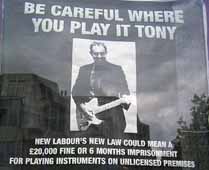 Spotted while out walking in Richmond today. Click here for more info about the Association of British Jazz’s campaign against Tony Blair’s licensing bill.
It was an appropriate spotting on the day that Mark Lawson wrote an excellent review in the Guardian of The Last Party, a new book by John Harris about the uneasy and short-lived cosying-up between “Britpop” and New Labour when the latter (and the former, come to that) was still trendy. The print version of the review features a cringing photo of Noel Gallagher having a laugh and a glass of champas with Blair back in 1997 – a time when we were all that much more innocent and Tone’s hair was still brown. (NB: Amazon is offering the £15 book at £10.50.)
Talking of Noel, I wonder what Tone’s four-noun autobiography title would be? Suggestions please.
* * *
And talking of Tony, Matthew Parris writes in today’s Times about “the evidence that millions of ordinary people are not amnesiacs, do remember why Mr Blair said Britain must attack [Iraq] and do still care whether that was true.” Along the way, old Tory Parris unnecessarily compares Margaret Thatcher favourably to Blair to back up his argument, but it’s otherwise an excellent piece.
* * *
Also superb in today’s Guardian Review is this essay by E.L. Doctorow about how he started writing, concluding with this interesting thought: “I believe nothing of any beauty or truth comes of a piece of writing without the author’s thinking he has sinned against something – propriety, custom, faith, privacy, tradition, political orthodoxy, historical fact, literary convention, or indeed, all the prevailing community standards together. And that the work will not be realised without the liberation that comes to the writer from his feeling of having transgressed, broken the rules, played a forbidden game without his understanding or even fearing his work as a possibly unforgivable transgression.”